How To Create Responsive Blogger Templates.

Do Your Best

Video of the Day

Latest Post

Thursday, August 1, 2019

0

How to Create Your Road Map to Success (A Step-By-Step Guide)

veryone has their own definition of what success means to them. Well, at least we all should by the very fact that no two individuals are created 100% alike.
Our road map to success should be different to the person standing next to us. But we can get caught in the dangerous trap that someone else’s ideas of success should also be ours. Be careful.
Regardless of whether or not we’re talking about your working career, business or personal life, it is truly hard to resist the contagious excitement surrounding those fantastic dreams and goals you allow yourself to explore.
The ‘come-down’ after attending a euphoric state-inducing personal development seminar can often result in you feeling the slump of post-seminar blues. Worse still, your everyday circumstances don’t accommodate the changes you swore to make that weekend. Nothing changes.
Get ready to kiss goodbye the post-seminar blues and skip to each destination on your roadmap to your successes. By repeating over and over these simple steps, the quality of your life will improve.
You will want to use these steps as standard strategies to carry you toward further success in whatever shape or form you choose.

1. Define What Success Means to You

Is it just having enough money or more money than you might ever need that allows you to feel and judge yourself a success? Is it about having a beautiful house worth more than $2,000,000 on the upper east side of Manhattan?
Is it about having a loving partner who supports you in your endeavors? Do you equally support each other?
Is it through the tertiary education roadmap that you only feel valid you can make a meaningful and successful contribution to help the world economy turn? Is that your definition of success or is it someone else’s? Maybe your mom’s or your dad’s?
When her daughter Christina found her on the floor of her office, in a pool of blood having hit her head and breaking her cheekbone as she fell, CEO of Thrive Global and celebrated author of Thrive, Ariana Huffington had a wake-up call in more ways than one.[1]
The exhaustion and overwhelming stress which had led to her fainting drove Huffington to radically introduce new work ethics, values and rules at the editorial.
Ten years on from her accident, Huffington still leads the conversational charge amongst global leaders to change the badge of honor that successful people need to work 24/7, and give everything of themselves and more, even it means compromising their health.
As opposed to letting power and money be the two measurements of success, she explains wisdom, well-being, wonder and giving will give you greater success by nurturing your psychological well-being.
We can’t argue with Huffington that without that, we are proverbially dead in the water.
Warren Buffet stated the way he defines success nowadays has nothing to do with money:
“I measure success by how many people love me”.
You can’t but fall in love with the wisdom and nobility these words seem to reflect, but keeping it as your only definition of success is probably dangerous. Lacking today’s wisdom at 20 years of age, would Buffet have had the same definition of success?
Think about where you are on your journey. You are likely to have different goals and different measures of success as you navigate your roadmap. Huffington and Buffet explain non-tangible ideas of success are crucial for our overall success.
Let’s also not forget though that through tenacity, persistence and many other success habits, these business leaders also rate extremely high on the power and money metrics. However, that’s not all there is to it.
If you are not sure how you would answer if someone asked you what your definition of success is, here are some clues to get you thinking and feeling.
As your head hits the pillow and before you close your eyes, what’s most important is that you can internalize that you have chosen your definition of success and you can full responsibility and accountability for deciding upon it.

2. Review Your Progress and Satisfaction in Life

Review the main areas of your life. Not just those where you feel you need to make changes. Review all of them:
  • Your career vocation or business life;
  • Your relationships – your intimate or life partner, family and friends;
  • Money health and financial management strategies;
  • Commitment to your faith or religion and spiritual personal development;
  • Your physical and mental health;
What leisure or recreational activities you pursue for fun to energize your spirit and enrich your soul.
Do you have ideas of what success looks like for you in each of these areas?
Neglecting to look at even one area is like trying to restore function to a beautifully crafted Swiss watch, whilst failing to attend to a rusty-looking cog in the tiny internal workings that needs attention. Turn one cog, the others all turn. Ignore a damaged one, the system malfunctions.
For each area, give yourself a rating out of ten – one signifies the least satisfaction and ten signifies the most – and ask yourself the following questions to help you start identifying what’s important to you:
  • How satisfied or content with this area of my life am I presently?
  • Where would I like to live this current level of contentment to?
  • What would that new level of satisfaction look like, feel like?
  • How important is this area compared with the other areas of my life?
Regardless of what areas you recognize need to be your core focus, consider making personal development and improvements to your physical and mental health, and well-being a constant feature of your action plan.
You will need to continually recognize obstacles you’ll face from your outside world, as well as those internal psychological battles that will arise from within.
Without your mental and physical health intact, it’s unlikely the rest of the ‘cogs’ are going to turn properly.

3. Get to Know Your Values and Priorities

Don’t make the mistake of thinking goal setting can be done in one sitting. You want to make sure the pursuits you put down on paper aren’t fly-by-night moments of excitement that ebb and flow with the rise and fall of tidal trends.
Become better at identifying your priorities by exploring how you feel about each of your life areas. Think about the ratings of satisfaction you might have denoted for each. And now write down what you want to be, do and have.
Put aside your initial literary ramblings and revisit them in a couple of weeks or one month. Without looking at your initial thoughts, do the process again and see what consistencies show up. What keeps coming up as feeling important? Around what ideas is there the same yearning or emotional pull?
If you’re unsure about what you feel you wish to head towards, be in allowance of this. Don’t be jumping to quickly fill the void. The desperation is likely to have you catching the tail of the last exciting concept in fear of missing out, or trying to fill the void of excitement you yearn for.
Increase your practice of pausing and asking yourself:
Why does this resonate with me? Could this be a distraction which complicates the route I have mapped out? Am I becoming that person who proverbially chases two rabbits and catches none?
In his book The Heart of Love, Dr. John Demartini explains how becoming strongly aware of your values and priorities helps you understand why you are and where you are in your life at any given moment.
If you don’t know what you feel you stand for, look at where you direct your time, energy and attention. Look at your behavior and work backward.
You might think making money and creating financial wealth is high on your radar. However, if you spend more than you earn and allocate money to depreciating objects as opposed to appreciating assets, your behavior is inconsistent with those typical of someone who is financially astute.
Look back to your areas of life and ask yourself if the goals you have set are in alignment with your values. Look at your daily behaviors and ask yourself if the way you operate satisfies steps which take you further toward those goals.
If not, all is not lost. You’ve simply got some harsh truths and reality checks to face before you can go any further on your roadmap to success.

4. Make Room Deliberately to Work with a Coach

You have to come to terms with the fact that you’re likely to be swimming against the tide.
Once you make clear unwavering decisions about what goals you’re aiming for, prepare to be un-liked, unpopular, criticized and potentially ostracized. There’s a high possibility you’ll lose the friendship and support of some however you will gain new friends and the support of others.
Regardless of what area/s of life your goals pertain to, make room to work with a coach. Choose wisely who that person will be to encourage and walk beside you.
Whether it be a certified coach, a family friend/mentor or qualified therapist, find someone who knows how to work with the specific issues and challenges that lay ahead without any agenda other than your success.
Having that impartial guide can be an invaluable constant. This helps keeps you on the straight and narrow even if other areas of your life aren’t going swimmingly.

5. Get Highly Familiar with Your Habits and Behaviors

Despite the scientific evidence in support of it, we’re not recommending you need to start getting up at 5:00 am and exercising for an hour before you even think about starting your day.
You should start asking yourself these questions far more frequently:
  • How well do you know your habits and routine ways of operating?
  • Do you know what choices and patterned behaviors help or hinder you?
You know what you want to work on. Greater clarity on your values has enabled you to discern which priorities are high on your list and which ones are low. It’s now time to reinforce and reward the habits that carry you forward on your roadmap to success, and adjust those habits which delay or divert you staying on course.
Remember though that part of the joy of the human experience is to be fallible, so don’t suddenly shelve all those character-building ‘vices’. Your flaws are a necessary part of your unique success jigsaw puzzle; they are the inspiring reasons you’re going on this journey in the first place.
Demartini and New York Times journalist and author Charles Duhigg both explain in their books how recognizing your unhelpful behavioral patterns needs to take place first. You identify the emotional and psychological rewards which rule over whether you sustain, break or make a habit.
When you know the rewards that light you up like a Christmas tree, you link them to new or modified habits that support values you want to make a higher priority.
Say you love eating out. You love artisan cuisine and get giddy at watching the episode of Heston Blumenthal create chocolate water in his food chemistry laboratory. As much as you say you want to increase your investment in appreciating assets, your spending habits speak otherwise.
So, you might start looking for discount opportunities on your higher-end dining. The dishes may not rival Heston’s masterpieces, but your taste buds still enjoy a culinary roller coaster AND you also now to get feel-good allocating the discounted amount to a saving’s program.
Your tummy is singing as is your bank account. The whole experience goes well beyond short-term gratification and satisfies several values and goals.
Tweaking habits and forming new ones isn’t hard; it’s just a matter of finding a happy marriage. Take time to find it. There will always be ways.

6. Celebrate the Wins and Monitor Your Progress Along the Way

You must become good at deliberately rewarding yourself when you make changes that take you further along your roadmap to success.
Professor of cognitive neuroscience Dr. Tali Sharot explains how the brain responds and adapts far better to rewards than punishment when it comes to learning behavior and creating new habits.[2]
When we apply punishment, we reinforce the traumatic memory as being more important than the actual lesson we might have been meant to learn in the first place.
When we gamify rewards on our success journey, we inject fun and humor. We also reduce the stress that often comes with learning new things, habits and adjusting to new ways of being, doing and having.

Final Thoughts

If you hit a progress plateau at any point, you might need to allow yourself to plateau and switch your attention to another priority.
The switch may allow you to think more freely and clearly about how to move past your roadblock. Or it might simply be a good time to stop and smell the roses.
Your muscles grow stronger in their resting phase after a workout. Animals hunt profusely to build up their energy stores before going into hibernation.
Remember that continually forging ahead is not a natural rhythm. Repeat the cycle of rest, recovery and rallying forward then…start again.

More About Success


0

Follow This Simple Success Formula to Stop Feeling Stuck in Life

Life can come as a roller coaster sometimes. It is tough to be the best version of yourself as you constantly meet with obstacles and life’s changing dynamisms. To move on to a different plateau, you may need to be more strategic and systematic in your approach to life.
I have been there. I know how it feels to get stuck and having nowhere to go. Yes, you may feel lost and don’t know how to come out from that hole. One thing I know though is that you can always get out and find a solution. It all starts with changing your thoughts and actions.
These steps are not hard but can be a simple success formula which when taken can create lasting changes in your life.

Be realistic

There is nothing that can move you forward in life until you are realistic enough to admit something is broken. Everything is not okay, you don’t need to pretend or butter the truth.
You have to be completely honest with yourself, take full responsibility for your life at this point and push forward.
You have to admit that you’ve made poor decisions, you have made some mistakes and may not be working as hard as you should be. Yet, there is hope if you can be brutally honest with yourself and move forward from there.

Make that choice to be different

Perhaps you are stuck with doing the same routine, going to the same places and being in the wrong circle. It is up to you to point your life in a new direction.
Yes, you could already be disgusted with the current one and need to do things differently. It is important for you to get fed up with the world you are in, so you can make a choice for something better. Making such decisions has a way of changing everything!

Look for something you’re really good at

Your life may be boring in certain areas, but it doesn’t have to be boring in all areas. Y
ou may need to shift your mindset and go back to those things you have always been fond of. When you can find such passion, you should make that decision to become better at it.
Change can be a slow process, but continually putting in the work every day could see your life change full circle.

Ask the right questions

“What could I do to be better?” “How can I make the most of your time?” “Where and when did it go wrong?” “What am I not doing right?”
You can’t take it away, asking the right questions will always lead to great answers.
You really need to be introspective when asking those questions about your life, where it is now and how you can position yourself for it to be better. The answers you get will be what leads you to finding a surer and more certain path to become happier and more successful.
You could also ask others what you are really good at and what role they see you taking on. You don’t need to simply ask anybody, ask the people who are already living the life you desire. Surely, they should be able to point you at the right direction.
At the end of the day, know that it is your duty to seek the life you desire, and perhaps asking smart questions could be what leads you there.

Push your mental powers

Your thoughts have a way of guiding you to living the best life. You become what you think about most of the time. You shouldn’t just accept things the way they are, do something about it.
Don’t complain about how terrible your life has become, rather do something about it. Look for ways to be better at what you do.
By thinking right and positively, you will certainly take charge of your life and respond actively to those things that happen to you.
Remember, to every setback, there is a way out. If you are failing at your career or job, you may need to gain new skills. If you are broke and do not have the money to live the best life, go out there and look for a job or learn something.
There is always a way out of that dead-end job or relationship if you constantly apply yourself to thinking.

Get a mentor

It is an age-old principle of success to find yourself a mentor, someone who will act as a guide in helping you actualize your dreams.
Find someone doing well in a particular area in life, yes, you want to be like them and embrace their tutelage.
Having someone you can look up to inspires you to be better. They certainly would have a thing or two to tell you that would empower you to get out there to accomplish great things.
So go out there, look for positive role models that can certainly have a major impact in your life. Here’s how to find a mentor that fits you:

Be responsible

Complaining or playing the blame game won’t take you anywhere. If you want to stop feeling stuck, you have to learn to take responsibility for your actions and where you are now.
You don’t have to drain your energy with complaining or any negative vibe. Look at the bright side. Know that if you really act responsibly you will get out of any hole you are in.

Be aware

Knowing yourself helps you win a thousand battles. Self-awareness is pivotal to living the life of your dreams. Such knowledge about yourself helps you find those things that can push you forward to great accomplishments.
Perhaps you have been talked down to or doubt yourself, think about what you could do with your life. The people talking down on you or telling you that you can’t are really not the problem – you are actually.
And if you are the problem, you can also be the solution too. When you know who you are, what you want and where you are going, no one can stop or deter you.
So study yourself, accept your role in the events of your life and see how you can better your strengths to face the challenges that would come your way. Take a look at this guide and learn how to be more self-aware:

Assume total control of your life

On the path to success, nothing should be left to chance. Your life is your responsibility. You are the one in the driver’s seat. You have control over the decisions you make. You also have control over how you respond to events or other people’s actions.
Certainly, there will be obstacles along the way, however you should have a guiding philosophy or ideology that will take you forward.
How you want to be is what you will be anyways. You may not be able to control a lot of factors in your life, but you can control your destiny if you assume control of your attitude, personality and aspirations.

Improve your circle

Your circle could be a mirror of how you view the world. If you are in a negative circle that robs you of your joy and self-esteem, you are not really going to attain much.
Improve your circle of friends. Focus on quality rather than quantity. People that push you to become the best version of yourself or make you feel good about yourself shouldn’t be traded for anything in the world.

Get motivated

There are a lot of audio materials and self-help books that would help you find direction even when you are lost. Such food for the soul could help you see your strengths and abilities after all.
Yes, no matter how drained and down you are, there is always something you have to offer. Motivate yourself by listening to or reading positive materials. This way you can know that others have been where you are and they survived.
Stop listening to the naysayers, start listening to those who have the “I can” spirit.

The bottom line

No matter how you like it or not, change is a slow process. Not everything you wish for will come all at once. But those consistent daily efforts could make a lot of difference.
It starts with accepting where you are right now and being willing to put in the work to get out of your current position.
Feeling lost is a state of mind anyways. Making those necessary changes could create a lasting change in your life and take you to the right direction after all.


0

How to Listen to Your Inner Voice for Greater Fulfillment

Five years ago, my husband Jake was training for a triathlon. He had just purchased a new road bike and woke up one sunny Saturday morning to take it out for its first spin.
As we were lying in bed, he looked at me and said, “I don’t have a good feeling about this; I hope something doesn’t happen.”
I suggested if he had a bad feeling, maybe he shouldn’t go. He thought for a moment, his logical mind kicked in, and he replied, ”Of course I should go, it’s fine. I need to train. It will be okay.”
Fast forward two hours later when I got a call from an unknown number. I answered with trepidation, knowing exactly what this call was going to be. A man told he had just found my husband in the middle of the road. He had an accident and the ambulance was on its way. He would stay with him until it was there.
Turns out, he was lucky to have just broken his femur and hip. Jake knew that morning that something wasn’t right. But instead of trusting his intuition and listening to that inner voice, he went anyway. It happens to all of us.
You often hear people say, “Go with your gut”“Trust your instincts”“Follow your intuition” and “Listen to your inner voice.” That all sounds great, right? If only it were that easy.
With all the external noise and internal conflict, how do we listen to our inner wisdom?
When you can tune in to that inner voice, you can make better and faster decisions, solve problems with greater ease, and live a more fulfilled and happy life.
But HOW?
I’ve worked with thousands of people over the course of my career and have learned that while this inner voice shows up in a variety of ways for each of us, we ALL have it.
In this article, I’ll outline some tips and strategies for how to identify and listen to your own inner voice. If you can find that voice and truly listen, it can save you a lot of time, energy, angst….and perhaps even a broken hip along the way.
I understand this might be easier for some than others. But regardless of who you are and how you’re wired, I just know, in my gut something will work for you.

What Is Our Inner Voice?

Call it Gut. Knowing. Insight. Soul. Innate Wisdom. That’s the voice we’re looking for.
The dictionary defines intuition as, “the ability to understand something immediately, without the need for conscious reasoning.”
It’s a hunch. A feeling. An inkling. A sense.
In Malcolm Gladwell’s “Blink: The Power of Thinking Without Thinking”, he explores the inner processes of intuition and instinct, examining how we make snap decisions and judgments. He has numerous examples of people having a hunch, feeling or intuition and how, while there was no hard evidence to back them up at first, science and data eventually backed up what they knew to be true.
Did you know that 95% of our brain activity happens at an unconscious level? Studies from numerous cognitive neuroscientists show that only 5% of our cognitive activity (decisions, emotions, actions, behavior) comes from our conscious mind.
We are taking in information through all our senses all the time – and processing it at an incredible speed. So that intuition, hunch, inkling, sense, voice, is coming from masses of information we can’t even cognitively or consciously process.
Then there’s cognition. “The mental action or process of acquiring knowledge and understanding through thought, experience, and the senses.”
This is more about understanding. Problem solving. Discernment. Organizing.
This is the logical, thinking part of your mind. Weighing pros and cons; coming to rational conclusions based on data or other factors. These are the voices of reason which often try to override your instincts.

What If I Don’t Hear Any Voice?

Your inner guidance and wisdom aren’t always a voice in your head. Often, it’s a feeling, a sensation, image, energy or emotion. You might notice it your body. There’s no one best or way to experience your inner voice. The important thing is to identify when and where you feel it.
Is it a feeling in your gut? This is true for many of my clients and for me, personally. You may have heard the gut being called our “second brain.” This is because of the enteric nervous system (ENS). It can operate independently of the brain and spinal cord, and the central nervous system. We really can think with our gut![1]
Celebrity therapist and pioneering hypnotherapy trainer Marisa Peer has this to say: “The stomach is the seat of all emotions and your feelings are the most real thing you have; so the trick is to listen to your feelings. If something feels wrong, your inner voice is saying it is not right for you. If you get the horrible lurch in your stomach, your inner voice is telling you ‘this is wrong’.”
Perhaps it’s in your heart. When I asked a Jessie Gardner of HeySoul.com, a friend and colleague known for her acute sense of self-awareness where her inner voice resides, she said, “My heart for sure. Always my heart.” That’s no surprise, our hearts are very intelligent organs.[2]
“Most people don’t know this, but the heart can feel, think and decide for itself. It has around 40,000 neurons and whole network of neurotransmitters with very specific functions, which make it a perfect extension of the brain. It’s automatic, almost instinctive, as if a mysterious, primal voice were telling us that the center of our true being, our conscience, is located right there.”
Maybe the voice is in your head?
When I talked to my Dad about his inner voice, he balked at the idea of feeling it in his gut or heart. Instead, he shared about the voice that comes from the back of his head that talks to him not with him.
Try this: Look, Listen, Feel.
We experience inner wisdom in different ways. Maybe you relate to one of my examples? Maybe you “see” a picture, vision or image that comes up in your head. Perhaps you feel sensations in your body – energy, emotions or feelings. As we go through examples of how to listen, pay attention to how and where yours shows up.

Why Don’t We Listen to Our Inner Voice?

If this inner voice is so powerful and effective, why don’t we listen?

Logic or Reason Takes Over

We often have a feeling or a sense of something, just like my husband did, but very quickly, our logical mind kicks in to try to understand and comprehend what we feel. This especially happens when we don’t have data or information to back up our hunch or inner voice. We, and of course, others believe it’s not valid if we can’t justify or explain ourselves. So we push our instincts aside.
A recent client told me about how he ignored his inner voice not long ago. He dropped off his 16-year-old daughter at the mall. As she got out of the car, he thought, “I should tell her to make good choices.” But, because her friends were in the car and he didn’t want to embarrass her, he decided not to. His logic, reason and social graces took over. A few hours later he got a call from the mall police. His daughter had stolen a ring. “I knew I should have told her to make good choices.”
We often override our instincts with logic, reason, desire, and, in this case, societal pressure or social graces. But we don’t have to.

We Don’t like the Answer

Sometimes we know what we need to do, but don’t like the answer. This happens with clients all the time when I ask what they sense they should do. They answer, but then reply,“But I don’t want to do that!”
Once, a client told me the story of her wedding, and a knowing that she simply ignored. As she walked down the aisle, she knew that she should not marry the man standing in front of her. Truthfully, she knew long before that day. But she didn’t want to hurt his feelings, call off the wedding, let friends and family down. So, she went through with it. Inevitably, that marriage ended in divorce – and this story is all too common.

We Don’t Know How to Distinguish, Hear or Listen to It

That’s what the following strategies are for! Let’s dive in.

How to Tune into Your Inner Voice

Here are 9 different ways to tune into your innate wisdom and inner voice:

1. Find Quiet

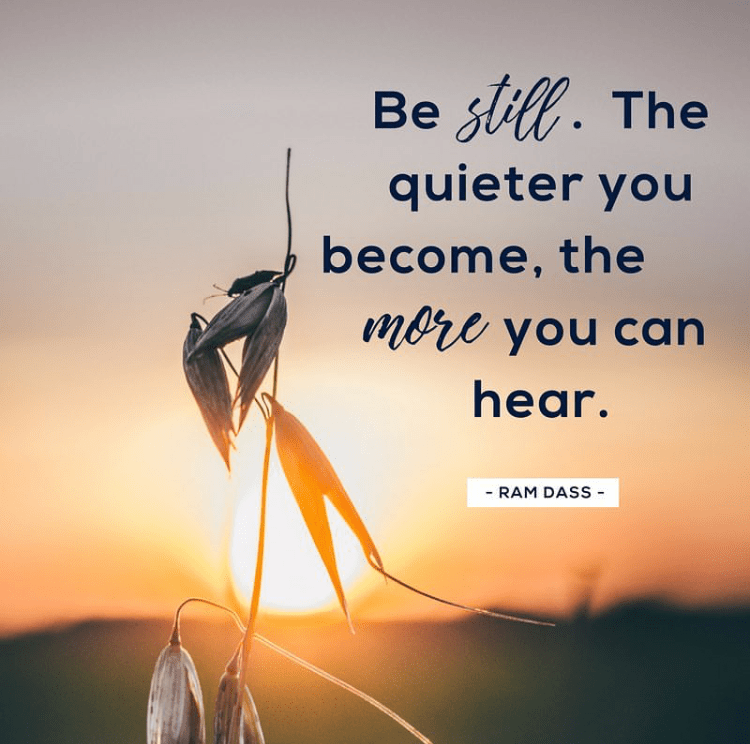
“Be still. The quieter you become, the more you can hear.” – Ram Dass
There are lots of ways to find quiet in the busyness of life. Turn off the phone, shut off the TV. Get some time and space to yourself.
You know what’s coming next, don’t you? Yes, I’m going to recommend you meditate. I know meditation seems to have become the panacea for everything that ails you, and there a good reason for that: it works. It’s one of the fastest, easiest and most effective ways to tap into your inner voice. Meditation aides us to connecting with our true self. Ma Jaya Sati Bhagavati said “If you quiet the mind, the soul will speak.” I completely agree.
Another great way to find quiet is to be in nature. Why? Because there’s a connection. It’s grounding. You’re able to tap into the “oneness” of everything. This can shift things energetically. Want the double whammy? Meditate in nature.
You might find your quiet in nature, meditation, yoga, exercise, prayer. Whatever it is, find your quiet.

2. Push Pause

Most of us are running a hundred miles an hour in every direction. It’s hard to hear anything at that pace. Have you ever been driving down the freeway with the windows down, listening to music, when the person next to you starts talking. Can you hear them? Of course not. It’s too loud. There’s too much going on. You need to roll up the windows, press pause on the music and stop.
Our inner voice is speaking to us all the time, but sometimes it’s just too loud or we’re too busy to hear it. Pressing “pause” allows to tap into our innate wisdom.
When I was studying Neuro Linguistic Programming (NLP), Mike Bundrant at the iNLP Center gave me a fantastic tool that I share with almost every client. It’s called the AHA Solution.[3] It’s often used to identify patterns of self-sabotage, but in this case, we can use it to listen to our inner voice.
Next time you have a feeling, a sense, a hunch or intuition, follow this protocol.
A. Aware: Be aware of what you are feeling. Pay attention and notice.
H. Halt: This is the pause button. Think about the ways you can respond to what you’re hearing or noticing. You could listen to your inner voice, ask more questions and seek to hear it further. Or, you could choose to ignore it completely and let your cognitive mind take over and convince you it’s okay.
A. Act: Now that you have options, decide which action you will take.

3. Invite Your Inner Wisdom to Show Up

If you want someone to come to your house, you’ve got to invite them over, right? Try taking this approach with your inner voice. While it’s always running in the background, it may have taken a backseat because it can’t seem to get through all the noise. It’s going to speak up more often when it knows you’re open and listening. Take a moment now and invite your inner wisdom to show up. Let it know you are ready and willing to listen. Wait to see what happens.

4. Ask Your Body

I love this one; our bodies are so dang smart. They will tell us if we ask and listen. But too often we have disconnected from sensations in our body to push through in the interest of productivity.
A few months back I was working with a client who came to our appointment with a massive headache. She stopped midway through our session and asked if I would mind if she went and took a couple Advil. Of course I said it was no problem, but asked if she was interested to understand the cause of her headache first. She nodded.
I had her close her eyes, take a couple deep breaths and ask her head, “What do you need from me right now?” The answer? “I need rest.” She burst into tears. She was exhausted but felt she couldn’t stop. She was leaving for a trip in a couple days, had her son’s birthday coming up and felt completely swamped. However, when she asked the question, her inner wisdom knew what she needed.
Try this at home. Next time you get something that’s bothering you physically, stop and be still for a moment. Ask that part: What do you need from me? What’s this about? OrWhat’s going on? And then wait and listen for an answer. This might sound a little out there, but trust me, it works.

5. Put It in Your ‘Slow Cooker’

When my Dad has a big problem he’s trying to solve or an important decision to make, he thinks about it before bed. I realize this might go against all advice regarding thinking about stressful things before bed, but that’s just the thing. He isn’t thinking about it or trying to solve it. He just puts the problem in the back of his mind for the night.
In the shower the next morning, solutions start bubbling up. These are usually spoken to him as if someone is talking to him. “What about this? Why don’t you do this?” It’s usually a very simple answer he hadn’t yet considered. And his response back to himself is frequently, “Why didn’t I think of that?” But he did!
This goes back to the 95% unconscious part that’s running in the background. When he stops thinking, his mind stops racing and puts the problem in the back of his mind, the unconscious part of him comes up with all sorts of great solutions. A colleague of mine used to refer to this as putting things in her ‘slow cooker’.

6. Flip a Coin

Have you ever flipped a coin, only to decide to do the exact opposite of what the coin said? Flipping a coin instigates our instinctive response because it gives us something to react to. When writing this article, My 7-year-old daughter was sitting at dinner one night, deciding who she wanted to put her to bed. She started doing the game, “Eeny, meeny, miny, moe.” Each time she finished, she landed on my husband. So, she went again. And again. Until six attempts later when she landed on me and replied, “I choose Mummy!” When a decision is taken out of our hands and happens to us, it gives us something to react to.
Try this with a decision you’re trying to make. Flip a coin. Are you happy and ready to go with that answer? Or do you want to go against the decision and try again? Well then, you already know what you want, don’t you?

7. Eat the Decision

I just had to include this one. I know it might sound a bit odd, but bear with me. Years ago, I read about a CEO who made all his big decisions this way. Let’s say he was considering acquiring another company. He would sit down and imagine he was eating that decision. Then he would stop and wait and see how he felt. Did he feel energized and alive or sick to his stomach? I love this idea and have tried it myself. It allows you to get out of your head and go into your body to make the decision. This might not be for everyone, but maybe it’s for you!

8. Take a Step

Sometimes you don’t know until you’re “in it.” When you’re faced with two choices, make the best choice with the information you have and what you feel is best, and then start moving. You’ll know if that choice is really right for you as you’ll feel good as you move forward. You’ll know it’s wrong if you continue to feel heaviness or resistance. The more you move forward the clearer the signal will become.

9. Get Some Help

Whether it be a best friend (who knows how to listen and ask the right questions), a coach or therapist. Having scheduled time to tune in and having someone ask the right questions allows you tap in to what you already know. You already have the answers within you, sometimes you just need a little help to uncover them.

Moving on with Your Inner Voice

Like with anything in life, practice makes permanent. It takes time to grow and nurture your inner voice, especially if you’ve ignored it or pushed it to the side for some time now. The more you listen and hone your skills, the better and faster you will become at hearing and listening to your intuition, your gut, your innate wisdom.
Play with the strategies above and see what works. Better yet, as you read through the ideas, identify which ones you felt or sensed would be good to try. Try those first.
Practice on small things first, like what you want to eat, what to wear or whether you want to attend that party Saturday night. You don’t have to start with major life decisions, whether you should buy that house or if you should take that job.
Then:
  • Notice when and where your feel your inner wisdom.
  • Notice when you feel a pull, have a hunch or instinct about something.
  • Notice when you have that sense and your mind tries to override it.
  • Notice when you start talking yourself out of something or start talking yourself into something.
Need more evidence that this will work for you?
Think about a time in your life when you recognized and listened to the inner voice – what was the outcome? Now, think about a time when you heard that voice, but for some reason, ignored it or pushed it aside. What was the outcome then? You, know, that time when you felt like you shouldn’t do something, but did anyway? Or had a bad feeling but kept moving forward?

Final Thoughts

Pay attention. Next time you have a bad feeling, a sense that something isn’t right, an inkling or a pit in your stomach, pay attention.
Following your inner voice will lead you to the truth of what’s best for you. Tuning into your innate wisdom will help you make better and faster life decisions, solve problems with greater ease, and live a life of greater happiness, success and fulfillment.
In the words of Madeleine L’Engle, “Don’t try to comprehend with your mind. Your minds are very limited. Use your intuition.”


Social Time

Facebook
Like Us
Google Plus
Follow Us
Twitter
Follow Us
Pinterest
Follow Us

Subscribe to our newsletter

(Get fresh updates in your inbox. Unsubscribe at anytime)